July 27, 2026 The Ruby Association has announced the Ruby Association Activity Report 2026, an in-person event that will showcase recent developments across the Ruby ecosystem, including keynote presentations, invited talks, and the results of the Association's 2025 development grant program. The event will take place on August 4, 2026, in Tokyo, Japan. Matz to … Continue reading Ruby Association Activity Report 2026: Matz, Fastly, and Ruby Grant Projects Take the Stage
Rails Isn’t Getting Bigger It’s Getting Sharper
Rails Isn't Getting Bigger It's Getting Sharper July 27, 2026 Every week, This Week in Rails highlights the latest changes merged into the framework. Most weeks, it's easy to focus on the individual features. But the July 10 edition suggests something more interesting: a broader trend in how Rails is evolving. Instead of shipping large, … Continue reading Rails Isn’t Getting Bigger It’s Getting Sharper
Ruby May Finally Fix the Famous “Norway Problem”
Ruby May Finally Fix the Famous "Norway Problem" July 21, 2026 The Ruby ecosystem may soon take an important step toward modern YAML support. Hiroshi SHIBATA (hsbt), a Ruby core developer, has introduced an experimental backend for the Psych library based on libfyaml, bringing full YAML 1.2 compliance closer to Ruby. While this might sound … Continue reading Ruby May Finally Fix the Famous “Norway Problem”
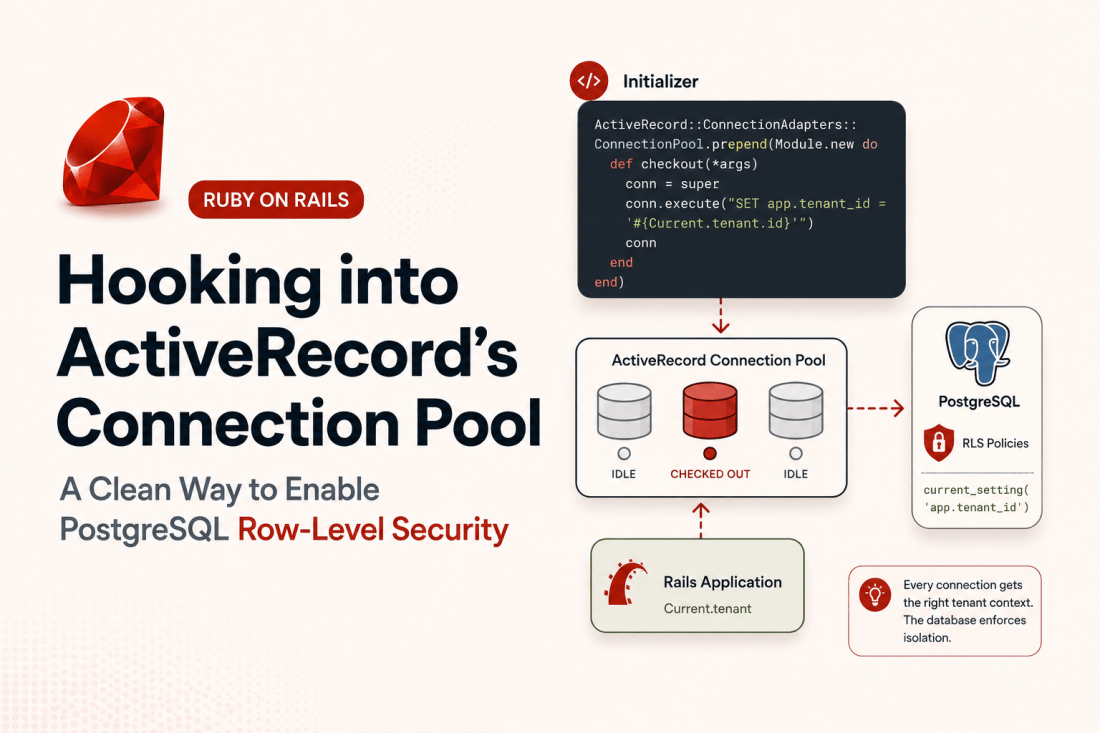
Beyond tenant_id: Treating Multi-Tenancy as a Database Invariant
Beyond tenant_id: Treating Multi-Tenancy as a Database Invariant July 20, 2026 Most Rails applications that become SaaS products follow the same trajectory. They begin with a single customer, acquire a second, then a third, and eventually someone adds a tenant_id column to every table. From that moment forward, every query is expected to remember to … Continue reading Beyond tenant_id: Treating Multi-Tenancy as a Database Invariant
β½ World Cup Fever Hits the Ruby Community
β½ World Cup Fever Hits the Ruby Community July 14, 2026 As the FIFA World Cup 2026 reaches its final stages, millions of fans around the globe are glued to every match. The Ruby community is no exception. Over the past few weeks, we've seen several developers build and share open-source Ruby and Rails applications … Continue reading β½ World Cup Fever Hits the Ruby Community
Why Ruby’s Issue Tracker Still Links to a 1991 Paper About Floating-Point Numbers
Why Ruby's Issue Tracker Still Links to a 1991 Paper About Floating-Point Numbers July 8, 2026 If you've ever been surprised by this in Ruby: (2.0 - 1.1) == 0.9 # => false you're not alone. Many developers initially assume this is a Ruby bug. It isn't. In fact, Ruby's own issue tracker includes a … Continue reading Why Ruby’s Issue Tracker Still Links to a 1991 Paper About Floating-Point Numbers
How to Safely and Efficiently Transform Payloads in Ruby and Ruby on Rails Workflows
July 2, 2026 Modern applications rarely consume external data exactly as it arrives. Whether you're integrating with payment gateways, CRMs, ERPs, or third-party APIs, incoming payloads almost always need to be normalized, enriched, or reshaped before they can be processed. A common workflow looks like this: Incoming Payload β βΌ Transformation Layer β βΌ Normalized … Continue reading How to Safely and Efficiently Transform Payloads in Ruby and Ruby on Rails Workflows
Dependabot Resolves Remaining Bundler 4 Compatibility Issues
Dependabot Resolves Remaining Bundler 4 Compatibility Issues July 1, 2026 Teams adopting Bundler 4 can breathe a little easier. After several weeks of community reports and investigation, the remaining compatibility issues between Dependabot and Bundler 4 have now been addressed through merged fixes in dependabot-core. The fixes resolve two separate issues that affected projects relying … Continue reading Dependabot Resolves Remaining Bundler 4 Compatibility Issues
Design Patterns, the Ruby Way (Part 3): Behavioral Patterns in Real Ruby Applications
Design Patterns, the Ruby Way (Part 3): Behavioral Patterns in Real Ruby Applications June 30, 2026 In the previous article, we explored how Ruby simplifies many creational and structural design patterns. But some of the most interesting patterns aren't about creating or organizing objects. They're about how objects collaborate. Behavioral patterns define how responsibilities are … Continue reading Design Patterns, the Ruby Way (Part 3): Behavioral Patterns in Real Ruby Applications
Design Patterns, the Ruby Way (Part 2): Modern Creational and Structural Patterns
Design Patterns, the Ruby Way (Part 2): Modern Creational and Structural Patterns June 28, 2026 In the first article of this series, we explored why Ruby changes the way developers think about design patterns. Features like duck typing, modules, blocks, and delegation often replace the ceremony required in more rigid object-oriented languages. Now it's time … Continue reading Design Patterns, the Ruby Way (Part 2): Modern Creational and Structural Patterns